
When you buy or sell a used electric car, one question matters more than any other: how far can it actually go?
Battery health is part of the answer, but only part. At Moba, we’ve built a range engine that goes much further. Here’s how it works.
Range is a physics problem, not a percentage
The quickest way to estimate a used EV’s range is to take the official figure and multiply it by the battery’s State of Health. A car rated at 400 km with 90% SoH becomes 360 km.
It’s simple, but it skips everything that actually determines how far a car goes: its weight, its shape, the speed you drive, the temperature outside, the hills on your route. So we took a different path. Every range on a Moba certificate (summer or winter, city, highway or mixed) is calculated by a complete physical model of energy consumption.
Expertise built from day one
Modeling how an electric car uses energy has been at the heart of Moba since the very beginning. Our team has built and refined models that track an EV’s battery level along any real-world journey: every acceleration, every slope, every change in temperature.
That know-how now powers every certificate we issue. We like to say we run the most accurate range estimator on the market.
Three inputs, one precise answer
Our model needs three things:
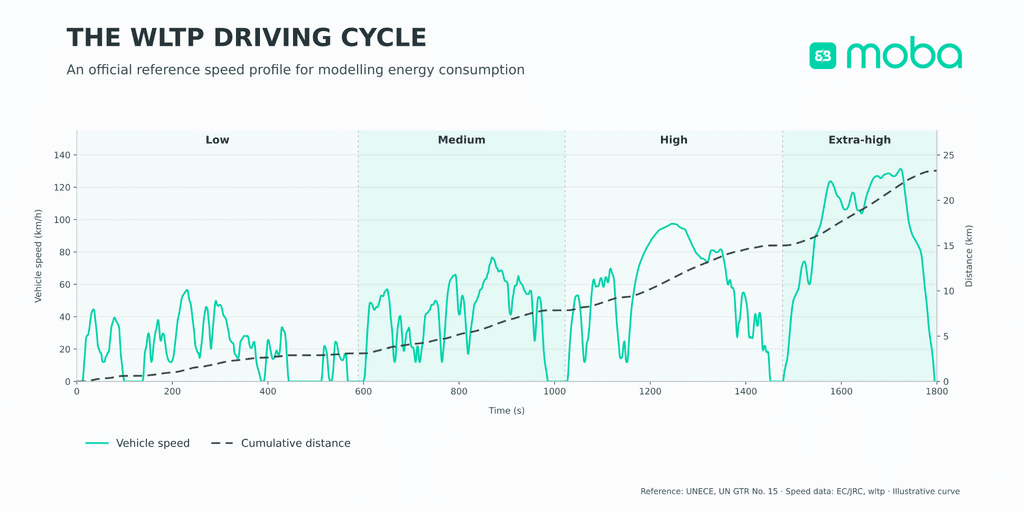
- A driving cycle: the trip itself, described as a sequence of speeds, how long each is held and, optionally, altitude changes.
- Driving conditions: mainly the outside temperature.
- The vehicle: its exact make and model, and its battery condition.
From there, our in-house database of every electric vehicle on the market provides the key characteristics: weight, battery capacity, aerodynamic profile, and how the battery’s voltage evolves as it charges and discharges.
Following every watt
At each moment of a trip, a car spends energy on five things:
- Air resistance. The faster you go, the more it costs, which is why highway range is lower.
- Rolling resistance. The friction between tires and road.
- Acceleration. Every time the car speeds up.
- Elevation. Climbing takes energy, descending gives some back.
- Climate control. Heating or cooling the cabin, a major factor in winter.
We combine these to get the power the car needs at every instant, then convert it into the energy actually drawn from the battery, including internal losses. We also account for regenerative braking, conservatively assuming that 40% of braking energy goes back into the battery.
Summed over the whole trip, this tells us precisely how much energy the journey requires.
From energy to range
For the WLTP range, we run the official WLTP driving cycle through the model. We compare the energy it requires to the battery’s actual remaining capacity, see how much charge the trip uses, and extend that to a full battery.
The same approach gives us realistic figures for every scenario we display: a cold winter commute, a summer road trip on the highway, a mixed daily drive.
A fun side effect: because our figures are calculated independently rather than scaled down from the brochure, a used car’s certified range can occasionally come out slightly above its original official rating, even with an SoH below 100%.
Why it matters
A battery health analysis tells you the actual state of the battery. A Moba range tells you what that battery can actually do on the road, in the conditions you’ll really drive in. That’s the information buyers, sellers and fleet managers need to make confident decisions, and it’s what we’ve built our expertise around.